


This is a new series of articles where I explain various terms, catchphrases, and other confusing topics, as well as many secret government projects and agencies. If there are any subjects you’re interested in learning about, please include them in the comment section.
Antifa’s Communist Roots, Violent Tactics, and Terror Designation
| By Jasper Fakkert |
| Far-left extremist group Antifa was propelled back into the spotlight last month when President Donald Trump designated it as a domestic terror organization by executive order. Earlier this week, two alleged members of the group were charged with providing material support to terrorists over an attack against law enforcement officers on July 5. In this week’s Top Story newsletter, we trace the origins of Antifa to Europe, where it was started as a united front program of the Politburo of the Communist Party of Russia in the early 1920s. It functioned as the violent wing of the Communist Party of Germany. We also interview Andy Ngo, an independent journalist that was targeted by Antifa for his reporting and was forced to flee the country. Ngo explains that despite claims by the group of lacking a formal structure, it is in fact very organized. 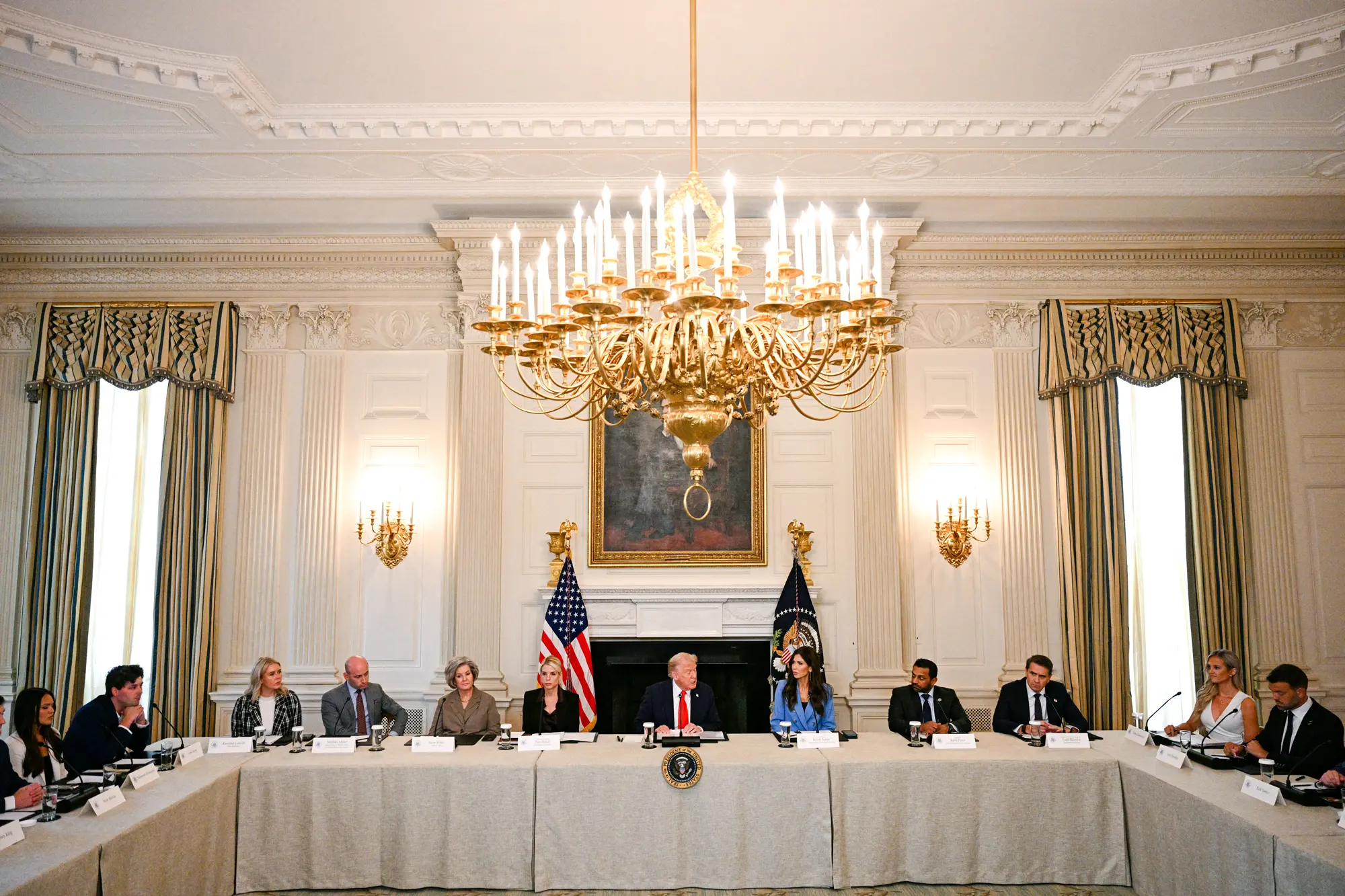 Law enforcement authorities said last month that they believe the 22-year-old suspect acted alone when he shot Kirk, but are investigating whether anyone else had a role in plotting the killing.President Donald Trump blamed “the radical left” for inspiring attacks against political figures such as Kirk. The far-left extremist movement known as Antifa has been tied to “a campaign of violence and terrorism,” Trump wrote in a Sept. 22 executive order, 12 days after Kirk was killed. Trump designated Antifa a “domestic terrorist organization” and ordered agencies to root out “any and all illegal operations” connected to Antifa and to prosecute perpetrators and their financiers. In a related memo, Trump highlighted “so-called ‘anti-fascist’ rhetoric” found on the alleged Kirk assassin’s unfired rounds.Trump’s executive actions and Antifa’s clashes with Immigration and Customs Enforcement in major cities are drawing more public attention to a once-obscure movement that remains hard to define.Trump said Antifa has recruited young people to riot, assault police, and obstruct federal agents, while also trying to squelch lawful political speech. Members of Antifa have long argued that people they deem to be fascists or oppressors deserve no platform to spread their viewpoints and that violence is justified if other silencing tactics fail. Alleged fascists must be stopped by “any means necessary,” the movement’s leaders say, and the phrase has become synonymous with Antifa. “Only mass antifascism, legal or not, can save us,” Mark Bray, author of “The Anti-Fascist Handbook,” wrote on the Bluesky social media platform on Oct. 4. Antifa’s ultimate goal is less obvious and more menacing than that, Trump and others warn. The president’s Sept. 22 order declared: “Antifa is a militarist, anarchist enterprise that explicitly calls for the overthrow of the United States Government, law enforcement authorities, and our system of law.” A trio of Democratic congress members and others denounced the Republican president’s order as an unenforceable, unconstitutional attempt to criminalize political opposition. Others pushed back against Trump’s description of Antifa as a group rather than an ideology. People victimized by Antifa, including some journalists, commend Trump for taking action against a shadowy movement that arose from communist roots and became increasingly influential, well-coordinated, and dangerous. How Antifa Started Antifascism began as a response to Italian dictator Benito Mussolini in the 1920s. His National Fascist Party was named after a symbol of penal power in ancient Rome, the “fasces,” a bundle of rods with an axe. Fascists embraced “extreme militaristic nationalism, contempt for electoral democracy and political and cultural liberalism,” according to Britannica. In 1932, Antifaschistische Aktion (Antifascist Action), a communist-led militant group that confronted Nazi stormtroopers in Germany, gave the modern Antifa movement its nickname and symbols that are still in use today, such as the raised-fist salute. The Antifa movement persisted for decades in Europe before spreading to the United States via punk rock culture. By the 1980s, a group called Anti-Racist Action had risen to prominence in the United States; later, it dissolved into smaller, decentralized groups. Since the 2000s, Antifa groups have grown globally, largely thanks to the digital age; encrypted messaging networks have enabled Antifa to communicate privately and evade detection. Although the most prominent Antifa groups in the United States are situated on the West Coast, the earliest groups emerged in the Midwest, including far-left skinheads known as “Baldies” in Minneapolis. What Is Antifa? Antifa, in many ways, defies description; journalist Andy Ngo and others told The Epoch Times that’s by design. “It’s meant to appear as if there is no organization, but they are organized,” said Ngo, author of the 2021 book that became a New York Times best-seller, “Unmasked: Inside Antifa’s Radical Plan to Destroy Democracy.” Ngo, the son of Vietnamese immigrants who escaped communism, delved into exposing Antifa for years in his hometown of Portland, Oregon. After repeated harassment, threats, and beatings—one severe enough to cause a life-threatening brain bleed—Ngo relocated outside of the United States. In 2020, when then-FBI Director Christopher Wray and others called Antifa “an ideology” rather than an “organization,” that description was correct but “incomplete,” Ngo said, because what matters is how people organize around that ideology. “Antifa is the decentralized movement of autonomous networks, groups, cells, and individuals who follow an ideology of violent anarchism and communism,” he said, adding that these people are united in their goal of destroying the United States and all of its institutions. He said Antifa often commits “violence for the sake of violence,” and may randomly smash a local business as “an attack on capitalism.” Although the Antifa Torch Network lists seven active U.S. chapters, no national Antifa group exists. And “there isn’t necessarily a specific shared ideology among those who label themselves anti-fascists,” according to a September report from the Armed Conflict Location and Event Data project. That nonprofit research group, based in Wisconsin, tracks political violence and protests worldwide. Antifa attracts socialists, communists, and anarchists, but some Antifa adherents may not align with any of those belief systems, according to the report. Antifa members often wave black-and-red flags and gather en masse in all-black clothing, known as the “black bloc,” a typical German Antifa tactic to make individual members harder to identify. But even those visual cues don’t reliably identify who is Antifa and who isn’t, the report stated. Terry Newsome, a Chicago-area parental-rights activist who became the target of Antifa death threats and doxxing after he became vocal about school COVID-19 restrictions in 2020, told The Epoch Times, that “there are tons of ‘Antifa wannabes,’” young people who think it’s cool to associate with Antifa. He’s also convinced that there are a lot of “paid, full-time agitators,” based on seeing the same people show up at numerous protests. Newsome said it would be preposterous for Antifa to have “an org chart,” showing who the group’s leaders are; illicit operations such as drug cartels don’t compile those or hand out membership cards. Neither does Antifa. An Insider’s View Gabriel Nadales, a self-described ex-Antifa participant, wrote in his 2020 book, “Antifa stands for antifascist, but the name is deceptive. … Anyone who dares to criticize the group or its tactics can be labeled a fascist.” In “Behind the Black Mask: My Time as an Antifa Activist,” Nadales said that many news reports “oversimplify this radical movement.”Anti-American sentiment is a primary driver of Antifa, he wrote, rather than opposition to fascism. While he participated in Antifa actions from 2011 to 2012, Nadales said, news outlets mistakenly reported that anarchists orchestrated events that Antifa had actually led. Rose City Antifa in Portland, Oregon, the nation’s oldest continuously active group using the Antifa name, formed in 2007 to “shut down a neo-Nazi skinhead festival,” its website states. To explain the ideologies it opposes, the group wrote: “Fascism can be hard to define. … The term has also come to be used to label any idea that is authoritarian, right-wing, or even just disliked.” Rose City Antifa lists numerous stances that it may consider “fascist,” ranging from white supremacy to opposition of labor unions; the group deems a movement “fascist” if it embraces “a majority” of the listed characteristics. “Militant opposition to fascism creates the social consequences that make becoming a fascist in the first place a lot less appealing,” the group states. Rose City Antifa says it doesn’t work with police or courts because “we cannot count on state actors to push forward the cause of justice, equity, and community safety.” Nadales said other leftists also commit violence, but “Antifa exemplifies the worst of this dangerous ideology, which is becoming bolder and more prevalent in American society.” “Many politicians refuse to see Antifa for the violent movement that it is because they blindly see Antifa as an ally—since it opposes President Trump,” Nadales wrote. “Further, they fear that Antifa will target them next.” Escalation During Trump Era When Trump was inaugurated as the nation’s 45th president, hundreds of protesters smashed windows, blocked traffic, and scuffled with police in Washington. Some of the black-clad vandals were reportedly Antifa affiliates, according to “The Anti-Fascist Handbook.” Bray wrote that he rushed to publish the 2017 book shortly after Trump first took office, feeling an urgency to combat “a resurgence of white-supremacist and fascistic violence” and the “tumultuous climate of the Trump era.” Trump’s name is mentioned at least 85 times in Bray’s book. Toward the end, Bray wrote, “Our goal should be that in twenty years those who voted for Trump are too uncomfortable to share that fact in public.” Bray calls the book “an unabashedly partisan call to arms.”Based on interviews with 61 current and former anti-fascists from 17 countries, the book argues that “militant anti-fascism is a reasonable, historically informed response to the fascist threat” that persisted after 1945 and became more “menacing” prior to Trump’s first presidency. Bray decried “an alarming lurch to the right” in Europe and the United States following the 2008 economic crisis.In 2016, while Trump was running for office, the FBI and Department of Homeland Security, under President Barack Obama, began monitoring Antifa as a domestic terrorist organization. Those concerns arose over violence at Trump campaign rallies dating to at least April 2016. In 2019, after Antifa activists attacked Ngo and others in Portland, Sens. Ted Cruz (R-Texas) and Bill Cassidy (R-La.) proposed designating Antifa as a domestic terrorist organization. The proposal went nowhere. Antifa Rises to Prominence Public awareness of Antifa soared during the summer of 2020. Members of the group sided with Black Lives Matter to protest against police and alleged “systemic racism” after the death of George Floyd, a black Minneapolis man, in police custody. Rioters destroyed businesses, set buildings and vehicles on fire, and fought with police across the nation. Antifa exploited “justifiable indignation” that many people felt over Floyd’s death, and “used the anger as a springboard to push their radical left-wing agenda,” Nadales wrote. The core motivation was not to demand police reform and prevent similar deaths, but rather that “the violence was targeted at destroying the private property of innocent Americans because Antifa hates capitalism and everything America stands for,” Nadales said in his book. As Bray wrote in his book, even as times changed, Antifa’s commitment “to stamp out fascism by any means necessary” remains intact and connects the movement to its earliest origins. Following Trump’s recent domestic-terror designation of Antifa, Bray and at least one other prominent Antifa adherent fled to Europe. Bray said he and his family no longer felt safe in their U.S. home. An Antifa organization that benefited from proceeds of Bray’s book announced that it had shut down donation-processing operations because of Trump’s order. The International Anti-Fascist Defence Fund took the step “to protect our donors and recipients,” its website states. The group said it was looking to resume operations “in a country not currently governed by fascists.” What’s Next? Trump said that his administration, led by Treasury Secretary Scott Bessent, is tracking down who is funding Antifa-related activities such as commercially printed signage. The president said those who financially support Antifa “are going to be just as guilty as the people that smack people over the head with a baseball bat.” Ngo said that some grants from philanthropic groups eventually filter down to Antifa, which also benefits from crowdfunding and donations from around the world. Some aspects of Antifa’s apparatus have moved underground, Ngo said, predicting that Antifa will “try to lay low, depend on the media to run cover for them, and hope that they get a Democrat in office again, who will undo the executive orders … [and] obviously not view Antifa as a domestic terrorist threat.” Ngo, who participated in an Oct. 8 White House roundtable discussion about Antifa, said he hopes that his reporting provides insights that will help investigators. He also suggests that, if people accept that Antifa opposes fascism, they should also wonder what the group supports. “What Antifa is for is violence, destruction, murder, an abolishment of the liberal democratic order,” Ngo said. “It’s quite actually ironic in many ways that Antifa act as shock troops for people who claim to care about those institutions and values and concepts.” Ngo suggested that rather than just listening to him, people should watch videos of Antifa violence, “and you can see how organized it is,” he said. “Watch that and then ask yourself, ‘What is that in furtherance of?’” –FBI agents revealed a clear resolve to implement President Donald Trump’s directive to disrupt and dismantle Antifa, a far-left group tied to violent protests and clashes with police and federal agents, according to a pair of nationally known media figures who said they were interviewed by agents. –Key figures linked to Antifa have fled the United States following President Donald Trump’s designation of the group as a domestic terrorist organization. Johan Victorin, founder of “Rose City Antifa,” a group based in Portland, Oregon, a city that has had frequent Antifa activity during protests, was seen on Oct. 6 in the city of Vaberg, Sweden, according to an X post and video by Swedish investigative journalist Christian Peterson. According to Project Veritas, which did an undercover exposé of Rose City in 2020, Victorin is a dual citizen of Sweden and the United States. –Two alleged members of a Texas cell of the far-left extremist group Antifa have been charged with providing material support to terrorists, in the first terrorism-related charges brought against people allegedly linked to the network over an attack against law enforcement officers that unfolded on July 4. –The Department of Homeland Security (DHS) stated on Oct. 11 that federal agents arrested a Chicago rioter for allegedly carrying a loaded firearm with “multiple rounds of ammunition” during protests outside an Immigration and Customs Enforcement (ICE) facility in Broadview, Illinois, last month. |

The Communist Origins of the Antifa Extremist Group
By Joshua Philipp
The extremist anarchist-communist group Antifa is in the headlines because President Donald Trump has announced that he will be designating it as a terrorist organization.
The organization was initially part of the Soviet Union’s operations to bring about a communist dictatorship in Germany, and it worked to label all rival parties as “fascist.”
Story continues below advertisement
The organization can be traced to the “united front” of the Soviet Union’s Communist International (Comintern) during the Third World Congress in Moscow in June 1921 and July 1921, according to the German booklet “80 Years of Anti-Fascist Action” by Bernd Langer, published by the Association for the Promotion of Anti-Fascist Culture. Langer is a former member of Autonome Antifa, formerly one of Germany’s largest Antifa organizations, which disbanded in 2004.
The Soviet Union was among the world’s most violent dictatorships, killing an estimated 20 million people, according to “The Black Book of Communism“ published by Harvard University Press. In terms of violence, the Soviet regime is second only to the Chinese Communist Party under Mao Zedong, which killed an estimated 65 million people.
The idea of the united front strategy was to bring together left-wing organizations in order to incite communist revolution. The Soviets believed that, following Russia’s revolution in 1917, communism would next spread to Germany, since Germany had the second-largest communist party, the Communist Party of Germany (KPD).
It was at the Fourth World Congress of the Comintern in 1922 that the plan took shape. Moscow formed the slogan “To the Masses” for its united front strategy and sought to unite the various communist and workers’ parties of Germany under a single ideological banner that it controlled.
“The ‘unified front’ thus did not mean an equal cooperation between different organizations, but the dominance of the workers’ movement by the communists,” Langer wrote.
Benito Mussolini, a Marxist and socialist who had been expelled from Italy’s Socialist Party in 1914 for his support for World War I, later founded the fascist movement as his own political party. He took power through his “March on Rome” in October 1922.
In Germany, Adolf Hitler became head of the National Socialist German Workers’ Party, or Nazi Party, in 1921. He mounted a coup attempt in 1923.
The KPD decided to use the banner of anti-fascism to form a movement. However, Langer noted that to the KPD, the ideas of “fascism” and “anti-fascism” were “undifferentiated,” and the term “fascism” served merely as rhetoric meant to support its aggressive opposition.
Both the communist and fascist systems were based on collectivism and state-planned economies. Both also proposed systems wherein the individual was heavily controlled by a powerful state and both were responsible for large-scale atrocities and genocide.
According to the 2016 annual report of Germany’s domestic intelligence service, the Federal Office for the Protection of the Constitution, from the viewpoint of the “left-wing extremist,” the label of “fascism” as pushed by Antifa often does not refer to actual fascism but is merely a label assigned to “capitalism.”
While leftist extremists claim to be fighting “fascism” while launching their attacks on other groups, the report states that the term “fascism” has a double meaning under the extreme left ideology, indicating the “fight against the capitalist system.”
This held true from the beginning, according to Langer. For the communists in Germany, “anti-fascism” merely meant “anti-capitalism.” He noted that the labels merely served as “battle concepts” under a “political vocabulary.”
A description of Antifa on the Federal Office for the Protection of the Constitution’s website notes that the organization still holds this same basic definition of capitalism as “fascism.”
“They argue that the capitalist state produces fascism, or at least tolerates it,” the website reads. “Therefore, anti-fascism is directed not only against actual or supposed right-wing extremists, but also always against the state and its representatives, in particular members of the security authorities.”
Langer wrote that, historically, by labeling the anti-capitalist interests of the communist movement as “anti-fascism,” the KPD was able to use this rhetoric to label all other political parties as fascist.
“According to this, the other parties opposed to the KPD were fascist, especially the [Social Democratic Party of Germany],” he wrote.
Thus, in a move that today would be considered ironic, the group that the communist “anti-fascists” most heavily targeted under their new label of “fascism” was the social democrats.
On Aug. 23, 1923, the Politburo of the Communist Party of Russia held a secret meeting, and, according to Langer, “all the important officials spoke out for an armed insurrection in Germany.”
The KPD was at the front of this call, launching a movement under the banner of United Front Action and branding its armed “anti-fascist” wing with the name Antifaschistische Aktion (“Antifascist Action”), a name Antifa still carries in Germany. Antifa organizations in other countries are rooted in this movement.

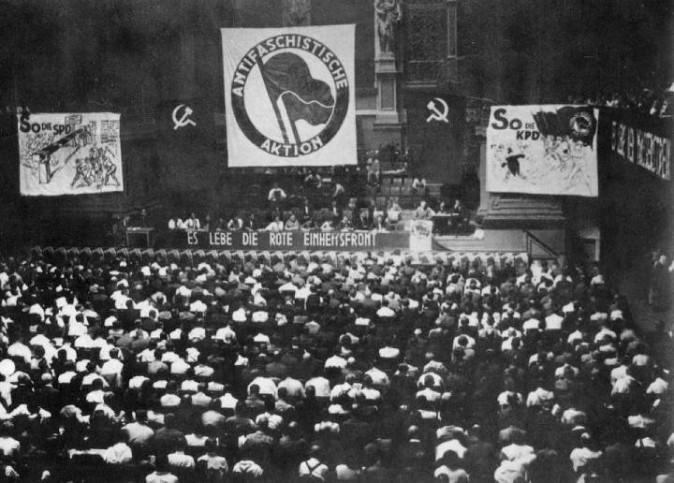
At this time, Hitler and his Nazi Party had begun to emerge on the world stage, and the Nazi Party employed a group similar to Antifaschistische Aktion in its use of political violence and intimidation, called the “brownshirts.”
Antifaschistische Aktion, meanwhile, began to attract some members who opposed the arrival of actual fascism in Germany and who did not subscribe to—or were potentially unaware of—the organization’s ties to the Soviet Union.
However, the violence instigated by Antifaschistische Aktion largely had an opposite effect. The ongoing tactics of violence and intimidation of all rival systems under the Antifa movement, along with its violent ideology, drove many people toward fascism.
“The Communists’ violent revolutionary rhetoric, promising the destruction of capitalism and the creation of a Soviet Germany, terrified the country’s middle class, who knew only too well what had happened to their counterparts in Russia after 1918,” Richard J. Evans wrote in “The Third Reich in Power.”
“Appalled at the failure of the government to solve the crisis, and frightened into desperation by the rise of the Communists, they began to leave the squabbling little factions of the conventional political right and gravitate towards the Nazis instead.”
Langer noted that, from the beginning, the KPD was a member of the Comintern, and “within a few years, it became a Stalinist party,” both ideologically and logistically. He wrote that it even became “financially dependent on the Moscow headquarters.”
Leaders of the KPD, with Antifa as their on-the-ground movement for violence and intimidation of rival political parties, fell under the command of the Soviet apparatus. Many KPD leaders would later become leaders in the communist German Democratic Republic and its infamous Ministry for State Security, the Stasi.
As Langer wrote, “Anti-fascism is a strategy rather than an ideology.”
Story continues below advertisement
It was brought into play in Germany in the 1920s, not as a legitimate movement against the fascism that would later arise in Germany, he wrote, but instead “as an anti-capitalist concept of struggle.”
What Is? Postings
https://common-sense-in-america.com/2024/07/12/what-is-agenda-47/
https://common-sense-in-america.com/2024/07/16/what-is-project-2025/
https://common-sense-in-america.com/2024/08/27/what-is-project-blue-beam/
https://common-sense-in-america.com/2024/09/03/what-is-project-mogul/
https://common-sense-in-america.com/2024/10/15/what-is-the-taft-hartley-act-and-how-does-it-affect-us/
https://common-sense-in-america.com/2024/11/12/project-stargate/
https://common-sense-in-america.com/2024/11/15/project-overmatch/
https://common-sense-in-america.com/2024/11/19/what-is-the-de-population-movement/
https://common-sense-in-america.com/2024/11/28/what-is-thanksgiving-day/
https://common-sense-in-america.com/2024/12/18/what-is-h-r-10445/
https://common-sense-in-america.com/2025/02/07/what-is-operation-midnight-climax/
https://common-sense-in-america.com/2025/02/14/what-is-project-63/
https://common-sense-in-america.com/2025/02/18/what-is-the-venona-project/
https://common-sense-in-america.com/2025/03/04/what-is-project-artichoke/
https://common-sense-in-america.com/2025/03/18/what-is-in-a-lyric/
https://common-sense-in-america.com/2025/04/04/arctic-strategy/
https://common-sense-in-america.com/2025/04/08/what-is-the-federal-reserve/
https://common-sense-in-america.com/2025/04/15/what-is-nfts/
https://common-sense-in-america.com/2025/04/18/what-is-cbdc/
https://common-sense-in-america.com/2025/04/25/what-is-brics/
https://common-sense-in-america.com/2025/05/02/what-is-project-sunshine-and-project-gabriel/
https://common-sense-in-america.com/2025/05/06/what-is-operation-underworld/
https://common-sense-in-america.com/2025/05/09/__trashed-5__trashed/
https://common-sense-in-america.com/2025/05/20/what-were-the-oak-ridge-experiments/
https://common-sense-in-america.com/2025/05/16/what-is-darpa/
https://common-sense-in-america.com/2025/05/30/what-is-operation-chaos/
https://common-sense-in-america.com/2025/06/10/what-is-the-cias-operation-x/
https://common-sense-in-america.com/2025/06/20/what-is-operation-paul-bunyan/
https://common-sense-in-america.com/2025/06/27/what-is-operation-gladio/
https://common-sense-in-america.com/2025/07/08/what-is-operation-mockingbird/
https://common-sense-in-america.com/2025/07/15/what-is-project-bluebook/
https://common-sense-in-america.com/2025/08/05/what-is-the-mann-act/
https://common-sense-in-america.com/2025/08/19/what-is-wrong-with-our-world-ronald-reagan-and-the-october-surprise/
https://common-sense-in-america.com/2025/09/12/what-is-the-cloward-piven-strategy-and-how-is-it-destroying-our-country/
https://common-sense-in-america.com/2025/09/23/what-is-the-bohemian-grove/
https://common-sense-in-america.com/2025/09/26/what-is-project-overmatch/
https://common-sense-in-america.com/2025/09/30/what-is-a-chamber-of-commerce/
https://common-sense-in-america.com/2025/10/03/what-is-project-iron-eagle/
https://common-sense-in-america.com/2025/10/28/what-is-gerrymandering-and-how-does-it-affect-our-country/
https://common-sense-in-america.com/2025/11/25/what-is-the-phoenix-program/
https://common-sense-in-america.com/2025/11/28/what-is-project-bluebird/
https://common-sense-in-america.com/2025/12/09/what-is-the-health-alteration-committee/
https://common-sense-in-america.com/2026/01/13/antifa-what-is-it/