


I have written several articles on postings related to politics. A list of links has been provided at the bottom of this article for your convenience. This article will, however, address different aspects of these political events.
A new world order isn’t coming, it’s already here − and this is what it looks like
On Sept. 3, 2025, China celebrated the 80th anniversary of its victory over Japan by staging a carefully choreographed event in which 26 world leaders were offered a podium view of Beijing’s impressive military might.
The show of strength was deliberate and reignited a debate in Western media over whether we are on the cusp of a China-centric “new world order” to replace the U.S.-dominated international “rules-based order.”
But as someone who writes about geopolitics, I believe we are already there. It might be in flux, and the U.S. still has a big role in it, but a new world order has begun – and as it develops, it will look increasingly different than what it’s replacing.
A brief history of world orders
Global history can be understood as the rise and fall of different orders, defined as a given era’s dominant power relations and attendant institutions and norms.
From 1815 to 1880, the United Kingdom was the undisputed world superpower, with an empire and navy that spanned the globe. The period from 1880 to 1945 was one of imperial rivalries as other countries – largely European and the U.S. – sought to copy Britain’s success and replace its dominance. Supplanting that was the bipolar world of two competing superpowers, the Soviet Union and the U.S., marking the period from 1945 to 1991.
The fall of the Soviet Union was the beginning of a brief period, from 1991 to 2008, of a unipolar world centered on U.S. global dominance, military power and economic might. With the retreat of global communism, the U.S. increased its influence, and that of the international rules-based order it helped establish after 1945, through institutions such as the World Trade Organization, World Bank and International Monetary Fund.


It did not last long in the face of a long war on terrorism, the fiasco of the invasion of Iraq, the long occupation of Afghanistan and finally the 2008 global financial crisis that undermined U.S. strength and weakened domestic support for Washington’s role as the world’s policeman.
Toward a multipolar world
In recent years, a new multipolar world has emerged with at least four distinct sources of power.
The U.S. remains central to this world order. It is blessed with a huge territory, a dynamic economy and the strategic luxury of large oceans on its east and west and much smaller powers to its north and south. The U.S. had a global military presence in the previous bipolar and unipolar order. But the cost of this imperial overstretch has prompted Washington to shift the cost burden toward its former allies, leading to a new militarization in Europe and East Asia where most countries now aim to increase military spending.
There is also a change in economic arrangements. In the unipolar order, the U.S. promoted a frictionless free trade arrangement and economic globalization. This resulted in the global shift of manufacturing that in turn created a populist backlash in those countries where manufacturing employment was hollowed out.
Now, economic nationalism is becoming a much more common refrain than free trade. Long the promoter of purportedly open markets, the U.S. is now leading the way in resurrecting tariff barriers to levels that haven’t been seen on the global stage in decades.
The military realignments and growing trade barriers will make it increasingly difficult to assemble durable alliances. In the short term the U.S. can leverage its existing power to its advantage, but over the long term other countries will likely pivot away from too much reliance on the U.S. The American Century that publishing magnate Henry Luce famously described in 1941 has to all intents and purposes come to an end.
China is now a peer competitor to the U.S. in both economic and military power. Increasingly, under the powerful leadership of Xi Jinping, China openly seeks a more Sino-centric world order with institutions and a global arrangement to match. To that end, it is assembling an axis of resistance to a U.S.-dominated world order. Russia, suffering from post-imperial syndrome, is an important member but not an equal partner.
Russian power is limited to establishing a Eurasian sphere of influence across its former Soviet republics and disrupting liberal democracies. But in that, Russia is more of a spoiler than an architect of the new order.
And then there is Europe, facing what British Prime Minister Keir Starmer referred to as a “generational challenge” as the U.S. pivots away from Europe toward the Indo-Pacific just as Russia poses a more serious threat to Europe, especially for its easternmost states.
Europe is remilitarizing after decades of demilitarizing. Sweden and Finland joined NATO in 2023 and 2024, respectively. In the coming decades, Europe could emerge as an independent source of both economic and military power with a different agenda from the U.S. – more keen to confront Russia, less willing to support Israel, and perhaps more willing to engage with China.
But all three power centers – the U.S., China and Europe – will struggle with similar and unique internal challenges.
All of them have sluggish economies and aging populations. The U.S. faces growing inequality and political instability as it shifts from a liberal democracy to competitive authoritarianism. China has an untested military, a looming demographic crisis, a faltering economy and a forthcoming succession struggle.
Finally, Europe is beset with a nationalist populism and growing social welfare costs just as military expenditures are set to increase.
The growth of the Global South
This threefold division is strangely reminiscent of the tripartite global division in George Orwell’s “1984,” where Oceania, Eurasia and Eastasia fought a permanent war of shifting alliances.
But Orwell was writing at a time when much of what is now called the Global South was either under the informal or formal control of the superpowers. That is no longer the case in the Global South, especially in the case of the larger countries such as Brazil, India and Indonesia.
The Global South is not yet a coherent bloc, more an informal arrangement of independent actors that tend to hedge between the major powers.
A world in flux
Yet none of this new global reality means that things are now fixed. Indeed, the new world order is in a state of disruptive flux that promises years of growing pains. Both the U.S. and China need allies, and countries in the Global South will continue to hedge between the competing powers.


As such, the world is in for a process of constant jostling as the major powers seek alliances while dealing with domestic pressures. In that messy status quo, many questions remain: Who will be most effective in building durable alliances? Will China manage its internal challenges? Will Europe get its act together? Will Russia continue its disruptive ways? Could a post-Trump U.S., post-Putin Russia and post-Xi China move the world in yet a different direction altogether?
And there is one large question above all others: Can the major powers manage their competition through shared global interests, such as combating climate change, environmental pollution and pandemic threats? Or will mounting conflict in the newly contested areas of the Arctic, cyberspace, outer space and the oceanic realm, and in ongoing geopolitical hot spots provide the trigger for outright conflict?
All world orders come to an end. The hope is the old one is doing so with a whimper rather than a bang.
WHAT IS THE CHANGING WORLD ORDER?
The Changing World Order refers to the shift in balance of power between nations, where one empire falls and a new empire takes over. This phenomenon has occurred throughout history, with the average cycle lasting about 250 years for great empires, with the same factors eventually leading to their fall.
The current world order, commonly called the American world order, formed after the allied victory in World War 2 when the US emerged as the dominant world power. In 1944, the new world monetary system was laid out in the Bretton Woods agreement and established the dollar as the world’s leading reserve currency. Having the world reserve currency plays a key role in a country becoming the richest and powerful empire.
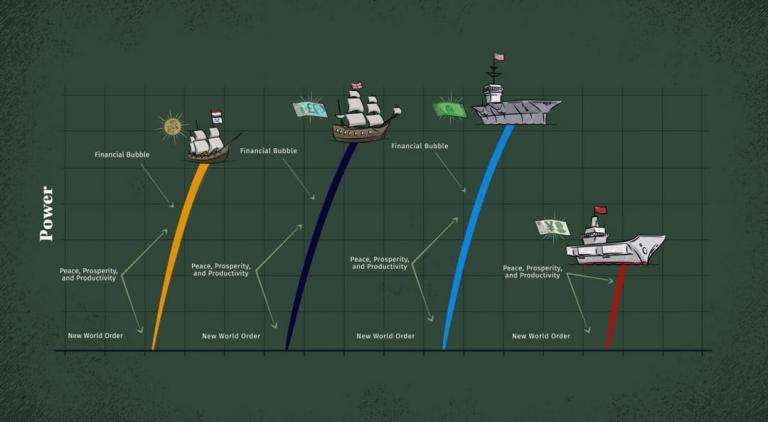
Before the US empire and US dollar held world reserve status, the empires that held the previous reserve currencies were the British empire and pound in the 1800s, and before that, it was the Dutch empire and guilder in the 1600s. As you can see, all reserve currencies in the past have been overturned by new ones eventually. Today, this is a relevant issue for investors to consider, as some are beginning to wonder whether, when and why the dollar will decline as the world’s leading reserve currency, what might replace it, and how that would change the world. To help answer these questions, it helps to take a look at what happened in the past.
What causes these major world leading empires to eventually lose their power?
In his study, Ray identified 8 key metrics to measure an empire’s power.
Those 8 metrics are: education, inventiveness and technology development, competitiveness in global markets, economic output, share of global trade, military strength, the power of their financial center for capital markets, and the strength of their currency as the world’s reserve currency.
Because each of these factors are measurable, we can use them to see how strong each country is today, compared to where it was in the past and whether they are rising or declining. This is important for understanding the change in power, by seeing which stage countries are in, it can help determine and anticipate future rises and declines of nations.
As example, Ray notes that, “For the first time in my life, the US is encountering a true rival power. China has become a rival power to the United States in most ways and is becoming strong in most ways at a faster rate. If trends continue, China will be stronger than the United States in the most important ways that an empire becomes dominant. Or at the very least, it will be a worthy competitor.”
This issue is becoming more relevant now as there is an increasing trend of countries de-dollarizing, meaning they are using less US dollars in the international financial system and markets. BRICS Countries, also known as Brazil, China, Russia, and India, have already taken steps to bypass the US-dominated global trade and financial system such as by trying to strike deals with other oil producing countries including Iran and Saudi Arabia to buy oil in yuan instead of USD.
Some experts warn that this poses a potential threat to the US as the world’s reserve currency, as this trend of de-dollarization continues. As example, the use of the yuan has increased over the past few years where it has now become the fifth largest payment as well as reserve currency, and the third largest in trade settlements.
WHAT IS THE BOOK THE CHANGING WORLD ORDER ABOUT?
Ray noticed three things that happened in recent years that led him to study changing world orders:
- First, countries didn’t have enough money to pay their debts, even after lowering their interest rates to zero. Because of this, central banks began printing a lot of money.
- Second, big internal conflicts emerged due to growing gaps in wealth and values. This showed up in political populism between the left and right.
- Third, increasing external conflict between a rising great power and the leading great power, as is now happening with China and the US.
He realized that all these events had happened together many times before in history. Almost every time, it led to changing domestic and world orders.
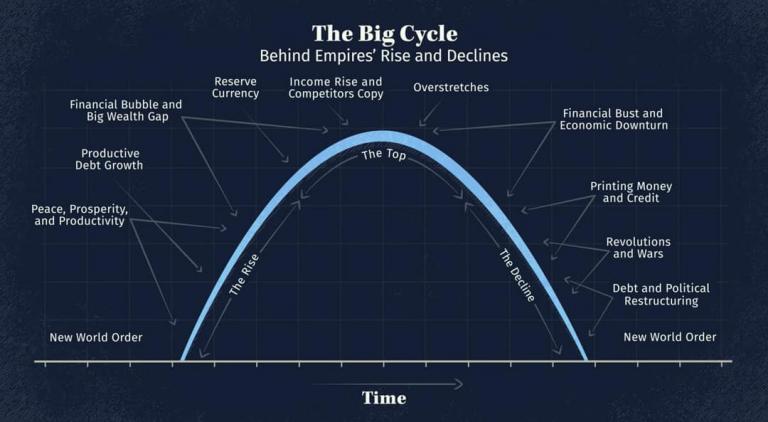
Ray explains a cyclical pattern known as the “big cycle,” which includes the emergence of a new dominant power and monetary system leading to the establishment of a fresh world order. This cycle occurs in a timeless and universal manner.
In a nutshell, the big cycle typically begins after a major conflict, often a war, which establishes the new leading power and the new world order. For example, the US rose to become the world’s superpower particularly after World War II.
This leads to the second stage of the cycle, where the resource-allocation systems and governments are built and refined.
Then, because no one can or wants to challenge this new power, there is typically a period of peace and prosperity, which is the third stage.
However, the cycle progresses to the fourth stage, which is characterized by people getting used to this peace and prosperity, increasingly betting on it continuing, so they borrow more money than they earn, the empire’s share of trade grows and when most transactions are conducted in its currency, it becomes a reserve currency, which leads to even more borrowing. At the same time, this increased prosperity distributes wealth unevenly, so the wealth gap typically grows between the rich and poor. All of this eventually leads to a financial bubble.
Eventually, the financial bubble bursts, which leads to very poor financial conditions, intense conflict between the rich and poor and results in the printing of money.
The empire begins to struggle with this internal conflict, and its power diminishes relative to external rival powers on the rise. When a new rising power gets strong enough to compete with the dominant power that is having domestic breakdowns, external conflicts, most typically wars take place.
Out of these external and internal wars, emerge new winners and losers. The winners then create the new world order.
The cycle begins again.
As Ray looked back in history, he saw that these same cause and effect relationships drove the rises and declines of empires all the way back to the Roman empire.

What are some practical takeaways from studying these historical cycles?
Ray shares two important principles that investors can use to help them make more informed decisions.
Principle 1: When central banks print a lot of money, buy stocks, gold, and commodities
One of the first principles Ray talks about in the book that he learnt after studying 500 years of history is that when central banks print a lot of money, buy stocks, gold and commodities because their value will rise, and the value of paper money will fall.
This happened in 1933 when paper dollars were linked with gold, which the US was running out of because there were spending more paper money than they had gold to exchange for, and then in 1971 when the US ran out of money again, defaulted on its debt and broke the paper currency’s link with gold, as well as it happened in 2008 to relieve the mortgage driven debt crisis, and most recently in 2020 to relieve the pandemic driven economic crisis.
In all cases, this allowed the US to continue to spend more than it earned, simply by printing more paper dollars. Since there was an increase in the number of dollars without an increase in the country’s wealth, the value of each dollar fell. As these new dollars entered the market without an increase in productivity, they went to buy lots of stocks, gold commodities, causing their prices to rise.
As he studied history, Ray observed the exact same thing happened in 1960 in the US, in 1850 in the UK, in 1650 in the Netherlands. He believes it will continue to happen again in the future.
Principle 2: To understand what is coming at you, you need to understand what happened before you.
Studying these important historical events led Dalio to come to a very important conclusion, which was that understanding history can be the greatest teacher and sometimes predictor of the future. This realization led him to study how the roaring twenties bubble turned into the 1930s depression. Studying this event gave Ray the lessons and knowledge to profit from the 2007 bubble, which then turned into the 2008 bust.
Understanding where we are in the cycle today can help anticipate where we might be in the future. While many famous investors like Warren Buffett and Charlie Munger often say that most economic and macro data is noise in the investment process, Ray Dalio provides an alternative view and believes that paying attention to these macro trends and specifically understanding cycles throughout history are crucial to not only his success as an investor, but can help all investors anticipate what’s ahead and make informed investment decisions.
WHAT IS AN EXAMPLE OF THE CHANGING WORLD ORDER?
One example of the changing world order is when the American world order formed after World War 2. In 1944, the new world monetary system was laid out in the Bretton Woods agreement and established the dollar as the world’s leading reserve currency.
Before the American world order and US dollar held world reserve status, the empires that held the last three reserve currencies were the British empire and pound in the 1800s, and before that, it was the Dutch empire and guilder in the 1600s.
Having a reserve currency enables a country to be able to borrow more than other countries. This is a huge advantage because people will be eager to lend out their dollars and if a country that is the world reserve currency, runs out of money, they can just print more. However, this privilege of having a reserve currency leads to increased borrowing and large debts with foreign lenders. This boosts spending power over the short term, but it weakens the country’s financial health and the currency over the long term.
In this cycle, the richer countries eventually get deeper into debt by borrowing from poor countries that save more, which is one of the early signs of a wealth and power shift. This started in the US in the 1980s when it had a per capita income 40 times that of China’s and started borrowing from the Chinese who wanted to save in dollars because of the dollar’s world reserve currency status. Similarly the British borrowed a lot of money from its much poorer colonies, and the Dutch did in their era. If the empire begins to run out of new lenders, those holding their currency, begin to look to sell and get out rather than buy, save, lend, and get in.
This is when the strength of the empire begins to decline.
Of the roughly 750 currencies that have existed since 1700, less than 20% now exist, and all of them have been devalued.
For the Dutch, this happened, after their defeat in the fourth Anglo-Dutch War when they couldn’t pay back the massive debts they built up during it. This led to a run on the bank of Amsterdam, leading to a desperate sell off and forcing massive money printing which devalued the currency and the empire into irrelevance. For the British, this happened after World War 2, when despite their victory, they could not repay the massive debts they borrowed to fund their war effort. This led to a series of money printing, devaluations, and sell offs in the British pound as the US and the dollar emerged dominant and created a new world order.
At this time, the US has massive amounts of debt, most on record, and spends more than it earns, funding this deficit with more borrowing, and printing huge amounts of new money, the big sell off in dollars and dollar debts hasn’t yet begun. That said, some experts believe it may be beginning. Particularly as there has been a shift in economic power from the West to the East and the trend of de-dollarization is occuring.
Over the past few decades, countries such as China and India have experienced rapid economic growth, and have emerged as major players on the global stage. These countries, along with the other BRICS countries (Brazil, Russia, India, China, and South Africa) that account for over 40% of the world’s population and just over a quarter of the global GDP have formed an alliance, and their collective actions to try to de-dollarize may pose a threat to the US as the world reserve currency.
7 key lessons from Ray Dalio’s ‘Principles for Dealing with the Changing World Order’
Ray Dalio’s ‘Changing World Order’ explores the rise and fall of global empires, offering investors timeless principles to navigate economic cycles, debt crises, and geopolitical power shifts.
Ray Dalio’s iconic book, ‘Principles for Dealing with the Changing World Order: Why Nations Succeed and Fail’, was first published in November 2021, it is a powerful tool for exploration and understanding of how global empires rise, reach their peaks, and then fall over time.
The book draws on over 500 years of research and data to identify repeating patterns in history. It tries to elucidate on what historical events mean for today’s turbulent world of equity markets.
Ray Dalio focuses on presenting a ‘Big Cycle’ framework that helps readers clearly understand the currently ongoing geo-political landscape, particularly the growing rivalry between the United States of America and China. Combining historical analysis, economic theory along with personal investment thesis, the book provides both a stern warning and a sensible guide for navigating uncertain times.
Who is Ray Dalio?
Ray Dalio is the founder of Bridgewater Associates, one of the largest and most reputed hedge funds in the world. Admired for his analytical approach to economics and his sincere commitment towards economic transparency, Dalio has devoted decades to study markets, geo-politics and human psychology.
With this book he focuses on global sustainability, offering a prudent framework to deal with economic changes when we have a transition time of shifting tides of global power for a leading super power i.e., the US to an upcoming super power China.
Here are seven key lessons from this influential work:
1. Empires rise and fall in predictable cycles
Dalio believes that nations follow a common path i.e., a path that emerges through strong leadership and innovation, rising through economic and military might and then eventually declines under the weight of compounding debt and internal strife. “The times ahead will be radically different from those we’ve experienced in our lifetimes, though similar to many times in history,” he writes.
2. Debt and money are silent killers
One of Ray Dalio’s core ideas is that long term debt cycles, especially when combined with money printing, often precede national decline. As money printing is nothing but adding more national debt on any nation’s economy. “Debt is a double-edged sword that fuels economic growth in good times and destruction in bad times,” he explains.
3. Education and innovation fuel national strength
Ray elaborates on the crucial role of human capital in national development, economic growth and progress. He believes that education and innovation cumulatively provide strength to a civilisation and help in building powerful empires. “The most powerful empires were those that achieved high levels of education, civility, and competitiveness,” he notes, linking societal progress, holistic development of the larger community with long-term prosperity.
Also Read | How ‘The Psychology of Money’ can transform your approach to investing
4. Internal conflict weakens nations
Rising disputes and inequalities in a nation, political polarisation and cultural fragmentation are serious red flags. Such differences weaken the core of a country and make future investments and growth difficult. “When the causes that people are behind are more important to them than the system, the system is in jeopardy,” Dalio further warns, highlighting growing divisions in the US and other major democracies are signs of long term structural weakness. Therefore, for economic prosperity, investments and growth it is crucial for the nation to gel as one and join hands to work together in achieving sustainable long term goals.
Also Read | 5 investing lessons from Jeremy Grantham on avoiding herd mentality
5. Military and economic power go hand in hand
A nation’s influence is backed not just by its economic power but also by its military might. Trade dominance, reserve currency status often correlate with strong and rigid defence capabilities. These elements holistically join to reinforce a nation’s global leadership. Since 1945 i.e., the end of the second world war, the US has been the leader of global trade and world order, but now China is also only the podium according to Dalio and is challenging the US.
6. China’s rise is part of the big cycle
Dalio considers China’s resurgence not a chance or a fluke, but as a natural part of historical power shift. “The United States and China are now in the classic late stages of the big cycle where a rising power challenges an incumbent one,” he writes, stressing that the currently ongoing geopolitical tensions are part of a much larger historical trend.
7. Adaptability is key to thriving in uncertain times
The final point to take note of for individual investors is to focus on adaptability. Dalio recommends preparing for difficult and volatile times ahead by diversifying investments, having a long term vision and continuous learning. “If you worry, you don’t have to worry. If you don’t worry, you need to worry,” he quips, stressing the value of proactive thinking in unpredictable environments.
Therefore, Dalio’s latest book is more than just a lesson in history and economics, it is in fact a blueprint for the global economy. By studying the past he suggests we can be better prepared for what lies ahead economically, politically and even personally.
Resources
-umbc.edu, “A new world order isn’t coming, it’s already here − and this is what it looks like.” By John Rennie Short;
-theinvestorpodcast.com, “Ray Dalio’s Changing World Order.” By Rebecca Hotsko;
-livemint.com, “7 key lessons from Ray Dalio’s ‘Principles for Dealing with the Changing World Order’.” By Shivam Shukla;
Governmental and Political Posts Both National and International
https://common-sense-in-america.com/2020/11/04/is-the-democratic-party-the-judas-party/
https://common-sense-in-america.com/2020/10/15/what-are-the-panama-papers/
https://common-sense-in-america.com/2020/10/11/what-amendments-will-be-in-jeopardy-under-a-democratic-government/
https://common-sense-in-america.com/2020/10/04/nominating-and-vetting-supreme-court-justices/
https://common-sense-in-america.com/2020/09/24/george-soros-revealed/
https://common-sense-in-america.com/2020/08/24/hud-housing-mandates/
https://common-sense-in-america.com/2020/09/28/roe-vs-wade-redux/
https://common-sense-in-america.com/2020/09/14/chinas-100-year-plan-for-world-domination/
https://common-sense-in-america.com/2020/09/13/when-the-soviet-union-collapsed-what-type-of-government-did-it-take-and-does-it-still-exist/
https://common-sense-in-america.com/2020/09/11/israel-and-the-united-arab-emirate-brokered-deal-how-big-is-this/
https://common-sense-in-america.com/2020/09/11/the-plot-to-destroy-america-when-and-how-did-it-start/
https://common-sense-in-america.com/2020/08/26/what-ruined-this-country/
https://common-sense-in-america.com/2020/08/25/how-to-make-our-country-great-again/
https://common-sense-in-america.com/2020/08/18/socialism-explained/
https://common-sense-in-america.com/2020/08/17/communism-explained/
https://common-sense-in-america.com/2020/08/05/can-american-win-the-war-for-the-world-market/
https://common-sense-in-america.com/2020/07/30/do-you-remember-the-movie-independence-day/
https://common-sense-in-america.com/2020/07/22/why-does-the-left-hate-this-country/
https://common-sense-in-america.com/2020/07/16/essential-and-non-essential-businesses-blast-from-the-past-or-not/
https://common-sense-in-america.com/2020/07/13/cancel-culture-needs-to-end-its-unamerican/
https://common-sense-in-america.com/2020/07/09/financial-disclosure-for-politicians/
https://common-sense-in-america.com/2020/07/10/athletes-speak-out-but-who-cares/
https://common-sense-in-america.com/2020/06/26/why-democratic-leaders-are-okay-with-the-destruction-of-our-statues/
https://common-sense-in-america.com/2020/06/25/how-would-the-left-respond-to-the-right-if-they-reciprocated-with-violence/
https://common-sense-in-america.com/2020/06/25/what-drives-the-agenda-of-the-democratic-party-fear-or-far-left-ideology/
https://common-sense-in-america.com/2020/06/23/violence-and-fear-as-a-tool-of-the-left/
https://common-sense-in-america.com/2020/06/23/why-are-state-and-local-leaders-allowing-looting-and-rioting-to-occur/
https://common-sense-in-america.com/2020/06/21/did-christopher-columbus-deserve-a-statue/
https://common-sense-in-america.com/2020/06/20/give-an-inch-take-a-mile-the-age-of-aquiescence/
https://common-sense-in-america.com/2020/06/19/daca-right-or-wrong/
https://common-sense-in-america.com/2020/06/18/should-tax-payer-dollars-be-used-to-rebuild-decimated-cities/
https://common-sense-in-america.com/2020/06/18/the-national-debt-dangerously-high/
https://common-sense-in-america.com/2020/06/17/open-our-country-now/
https://common-sense-in-america.com/2020/06/16/green-new-deal-what-the-hell/
https://common-sense-in-america.com/2020/06/14/public-figures-speaking-out-good-or-bad/
https://common-sense-in-america.com/2020/06/12/rejuvenating-our-infrastructure/
https://common-sense-in-america.com/2020/06/12/our-history-deserves-to-be-protected-not-destroyed/
https://common-sense-in-america.com/2020/06/10/should-we-be-afraid-of-china-our-asian-competitor/
https://common-sense-in-america.com/2020/06/09/why-the-left-socialist-and-communist-hate-religion/
https://common-sense-in-america.com/2020/06/08/insurrection-act/
https://common-sense-in-america.com/2020/10/26/history-of-the-republican-party/
https://common-sense-in-america.com/2020/06/06/what-makes-a-leader-great/
https://common-sense-in-america.com/2020/06/05/government-reform-proposal-february-17-1999/
https://common-sense-in-america.com/2020/10/25/history-of-the-democratic-party/
https://common-sense-in-america.com/2020/10/31/what-does-the-socialist-democratic-party-think-of-the-american-people/
https://common-sense-in-america.com/2020/11/03/green-new-deal-what-the-hell-part-2/
https://common-sense-in-america.com/2020/11/06/china-and-russia-are-among-the-worlds-worst-human-rights-violators/
https://common-sense-in-america.com/2020/11/07/how-does-the-biden-sanders-platform-compare-to-the-1936-ussr-constitution/
https://common-sense-in-america.com/2020/11/13/voter-fraud-in-2020-how-will-effect-future-elections/
https://common-sense-in-america.com/2020/11/14/what-will-happen-if-biden-reverses-trumps-accomplishments/
https://common-sense-in-america.com/2020/11/17/the-confederate-constitution-what-can-we-learn-from-it/
https://common-sense-in-america.com/2020/12/08/our-new-two-party-system-where-is-it-taking-us/
https://common-sense-in-america.com/2020/12/04/what-will-become-of-our-capitalistic-society/
https://common-sense-in-america.com/2020/06/12/what-every-leader-needs-to-be/
https://common-sense-in-america.com/2020/06/06/what-makes-a-leader-great/
https://common-sense-in-america.com/2020/07/05/4th-of-july-celebration-2020/
https://common-sense-in-america.com/2020/12/22/roosevelt-stalin-and-churchill-how-they-formed-our-world/
https://common-sense-in-america.com/2021/01/29/what-gives-the-top-1-percent-the-right-to-rule-the-world/
https://common-sense-in-america.com/2021/02/26/impeachment-dissected/
https://common-sense-in-america.com/2021/02/28/is-the-equality-act-about-equality/
https://common-sense-in-america.com/2021/03/09/1871-us-corporation-fact-or-fiction/
https://common-sense-in-america.com/2021/03/12/are-we-entering-into-a-global-nuclear-cold-war/
https://common-sense-in-america.com/2021/04/16/our-2nd-amendment/
https://common-sense-in-america.com/2021/04/20/did-kerry-collude-with-iran/
https://common-sense-in-america.com/2021/04/25/what-is-cancel-culture/
https://common-sense-in-america.com/2021/04/30/what-happened-on-january-the-6th-and-what-were-the-repercussions/
https://common-sense-in-america.com/2021/05/07/what-is-a-filibuster-and-why-is-it-such-a-big-deal/
https://common-sense-in-america.com/2021/05/18/how-are-the-democrats-changing-the-country/
https://common-sense-in-america.com/2021/06/04/the-steele-dossier-exposed/
https://common-sense-in-america.com/2021/06/29/did-senator-manchin-save-our-country/
https://common-sense-in-america.com/2021/07/06/what-is-up-with-greenland/
https://common-sense-in-america.com/2021/07/23/what-are-the-democrats-doing-to-maintain-power/
https://common-sense-in-america.com/2021/08/03/why-people-hate-capitalism/
https://common-sense-in-america.com/2021/08/31/was-the-death-of-george-floyd-part-of-a-plot-to-destroy-america/
https://common-sense-in-america.com/2021/10/01/our-9-11-responses-in-retrospect/
https://common-sense-in-america.com/2021/11/26/what-is-the-difference-between-human-infrastructure-and-physical-infrastructure-why-are-we-even-discussing-this-at-the-federal-level/
https://common-sense-in-america.com/2021/11/30/what-gives-with-the-lincoln-project/
https://common-sense-in-america.com/2021/12/03/what-is-project-veritas/
https://common-sense-in-america.com/2022/01/28/how-the-left-is-destroying-our-country-revisited/
https://common-sense-in-america.com/2022/02/01/debunking-the-squad/
https://common-sense-in-america.com/2022/02/11/how-the-quincy-pact-shaped-our-relationship-with-saudi-arabia/
https://common-sense-in-america.com/2022/02/15/the-china-federation/
https://common-sense-in-america.com/2022/02/18/the-russia-federation-part-two/
https://common-sense-in-america.com/2022/02/22/are-china-and-russia-buddies/
https://common-sense-in-america.com/2022/02/25/what-is-the-hidden-cost-behind-the-green-new-deal/
https://common-sense-in-america.com/2022/02/27/putins-desperate-attempt-at-regaining-lost-glory/
https://common-sense-in-america.com/2022/03/04/why-are-hong-kong-and-taiwan-important-why-we-cant-roll-over-beethoven/
https://common-sense-in-america.com/2022/03/11/is-our-country-being-governed-by-the-mob/
https://common-sense-in-america.com/2022/03/15/when-will-putin-get-his-head-out-of-his-ass/
https://common-sense-in-america.com/2022/03/29/the-human-cost-of-socialism-and-communism/
https://common-sense-in-america.com/2022/04/12/what-has-to-be-done-in-2024-to-restore-our-country/
https://common-sense-in-america.com/2022/05/24/greenland-and-iceland-what-rolls-will-they-play-in-the-global-arena/
https://common-sense-in-america.com/2022/08/09/what-happens-to-the-us-if-china-gets-taiwan/
https://common-sense-in-america.com/2022/11/25/what-is-happening-in-ukraine-and-what-are-they-doing-with-our-money-and-weapons/
https://common-sense-in-america.com/2023/01/03/how-the-liberal-democratic-leadership-has-ruined-our-country/
https://common-sense-in-america.com/2023/01/10/china-is-buying-up-our-country-how-afraid-should-we-be/
https://common-sense-in-america.com/2023/03/10/does-the-demise-of-the-monroe-doctrine-mean-the-end-of-the-us/
https://common-sense-in-america.com/2023/03/17/we-need-to-get-our-house-in-order-before-our-country-collapses/
https://common-sense-in-america.com/2023/05/12/what-causes-civilizations-to-fail/
https://common-sense-in-america.com/2023/05/23/what-purpose-does-lawlessness-serve-the-liberal-left/
https://common-sense-in-america.com/2023/08/13/u-s-hegemony/
https://common-sense-in-america.com/2023/10/27/we-should-not-be-surprised-about-corruption-in-politics-it-has-existed-since-the-first-government-came-into-being/
https://common-sense-in-america.com/2024/03/26/food-addiction-and-how-certain-foods-affect-us/
https://common-sense-in-america.com/2024/04/23/henry-kissinger-the-yom-kippur-war-and-the-oil-embargo-of-1974/
https://common-sense-in-america.com/2024/06/11/did-the-1998-bombing-of-iraq-ordered-by-president-clinton-precipitate-the-9-11-attacks/
https://common-sense-in-america.com/2024/07/09/what-is-the-supreme-court-chevron-decision/
https://common-sense-in-america.com/2024/09/17/former-top-clinton-adviser-calls-on-abc-to-launch-internal-probe-into-whether-debate-was-rigged/
https://common-sense-in-america.com/2024/09/17/abc-trump-harris-debate-whistleblower-affidavit/
https://common-sense-in-america.com/2024/09/22/we-were-wrong-this-is-not-just-an-election-it-is-a-war-for-our-very-survival/
https://common-sense-in-america.com/2024/09/27/how-soros-backed-organizations-leverage-waves-of-new-immigrants-to-sway-elections/
https://common-sense-in-america.com/2024/10/22/what-is-the-filibuster-and-why-do-the-democrats-want-to-get-rid-of-it/
https://common-sense-in-america.com/2024/11/25/trump-could-prompt-supreme-court-ruling-on-birthright-citizenship/
https://common-sense-in-america.com/2024/12/13/alejandro-mayorkas-and-merrick-garland-a-lethal-and-utterly-corrupt-tag-team/
https://common-sense-in-america.com/2025/02/10/inside-the-revolution-rewiring-american-power/
https://common-sense-in-america.com/2025/02/21/do-we-have-to-pay-taxes-2/
https://common-sense-in-america.com/2025/03/21/bin-ladens-letter-to-america-osama-bin-ladens-letter-to-america-transcript-in-full/
https://common-sense-in-america.com/2025/04/29/interim-report-on-the-failures-and-politicization-of-the-january-6th-select-committee/
https://common-sense-in-america.com/2025/08/01/what-happened-on-april-12-1937-and-how-it-shaped-our-government/
https://common-sense-in-america.com/2025/08/12/did-you-know-that-the-mlk-family-sued-the-federal-government-and-won/
https://common-sense-in-america.com/2025/09/05/china-has-come-to-the-table-but-this-fight-with-the-us-is-far-from-over/
https://common-sense-in-america.com/2025/09/19/how-edward-snowden-and-john-kiriakou-saved-our-country/
https://common-sense-in-america.com/2025/12/30/why-do-we-have-so-many-intelligence-agencies/
https://common-sense-in-america.com/2025/12/26/could-secession-happen-again-in-the-united-states/
https://common-sense-in-america.com/2025/12/16/what-is-the-terrible-truth-about-globalization/
https://common-sense-in-america.com/2026/01/02/will-china-replace-the-u-s-as-the-dominant-super-power/
https://common-sense-in-america.com/2026/01/09/the-changing-world-order/